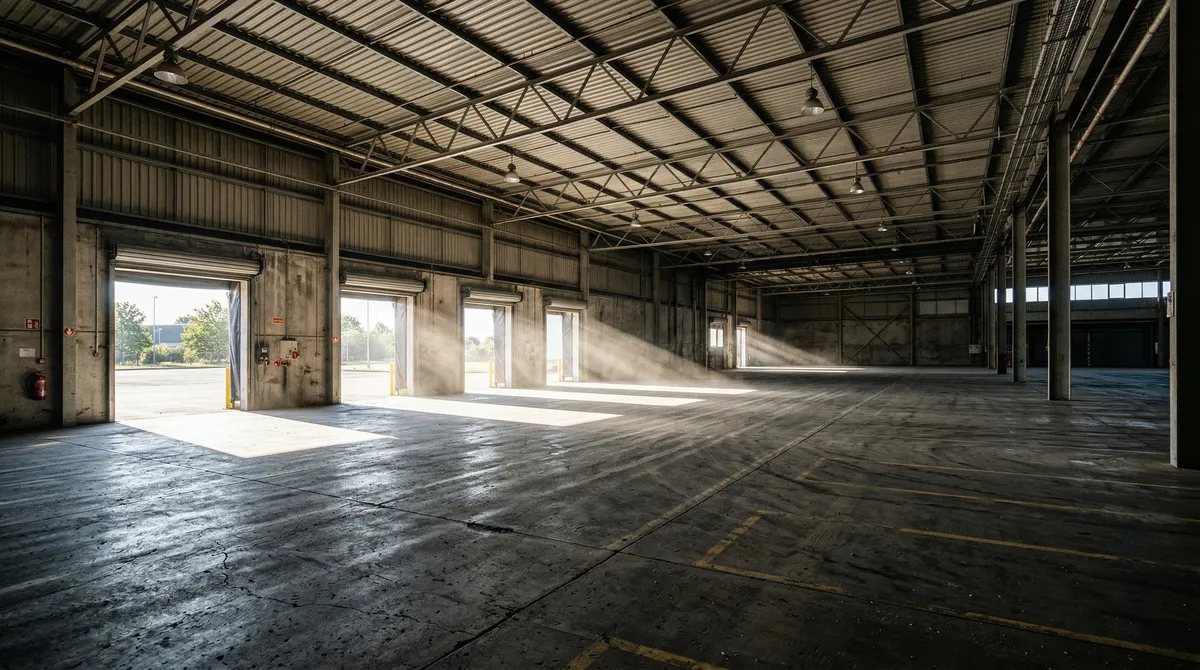
Warehouses don't get valued like the rest of commercial real estate
Market Value: Industrial properties in Massachusetts saw average prices climb to $314/SF in Q4 2025, reflecting limited supply and high demand from logistics and manufacturing.
Clear Height Impact: Buildings with 32-foot clear heights command a 10-15% premium over 24-foot buildings due to increased usable storage capacity.
Environmental Mandate: A Phase I Environmental Site Assessment is mandatory for industrial transactions in Massachusetts, as a clean report reduces risk while discovery of contamination can kill a deal.
Market Activity: Worcester County recorded 144 commercial trades totaling $571 million through Q3 2025, a healthy pace for industrial properties.
Phase I Environmental Site Assessment is a mandatory report for industrial property sales in Massachusetts that identifies potential environmental contamination and liability, ensuring a clean transaction or revealing deal-killing risks.
If you own a warehouse, distribution center, manufacturing plant, or flex building in Massachusetts and you're thinking about selling, start with this: industrial runs on its own valuation rules. What makes a warehouse sale worth money is not what matters in an office or retail deal.
Clear height beats finishes. Loading beats curb appeal. And the environmental history beats almost everything. The people who buy industrial in Central Massachusetts also look nothing like the people who buy a retail strip or a medical office building.
I've been selling this stuff around Worcester County for 35 years. Here's how the sale of a warehouse or industrial building actually goes in Massachusetts, from what makes your building worth money to the environmental and tax rules you won't run into on any other property type.
Industrial properties in Massachusetts averaged $176/SF through the first three quarters of 2025, climbing to $314/SF in Q4, driven by limited supply and sustained demand from logistics and manufacturing users.
Clear height is the single biggest physical value driver: buildings with 32-foot clear heights command 10-15% premiums over 24-foot buildings with the same footprint.
Phase I Environmental Site Assessments are mandatory for virtually every industrial transaction in Massachusetts. A clean Phase I removes a major deal risk; a surprise discovery during due diligence typically kills the transaction or triggers significant price reductions.
Worcester County recorded 144 commercial trades totaling $571 million through Q3 2025, putting the county on track for its third-highest annual transaction volume in a decade.
What your warehouse is actually worth to a buyer
The specs that set the price
Industrial buyers grade a building on how well it runs, not how it looks. These are the things that move price ahead of location, age, or aesthetics:
| Specification | What Buyers Want | Impact on Value |
|---|---|---|
| Clear height | 28-32 feet minimum; 32-36 feet for Class A | Each additional foot adds 7-10% usable storage capacity. Buildings under 20 feet trade at significant discounts |
| Loading docks | Dock-high doors with levelers; ratio of 1 dock per 5,000-10,000 SF | Inadequate loading = smaller buyer pool. Grade-level only limits users to light industrial |
| Column spacing | 40'x50' or wider bays | Narrow column spacing limits racking configurations and reduces usable storage |
| Power capacity | 800+ amps, 3-phase; heavy manufacturing may require 2,000+ amps | Upgrading electrical service costs $50,000-$200,000. Existing heavy power is a premium feature |
| Sprinkler system | ESFR (Early Suppression Fast Response) preferred | ESFR allows higher stacking. Older wet systems limit rack heights. Upgrading costs $3-$5/SF |
| Floor load capacity | 300+ PSF for warehouse; higher for manufacturing | Reinforced floors support heavy machinery and high-density storage |
| Truck court depth | 120+ feet for trailer maneuvering | Shallow truck courts prevent full-size trailers from docking, which eliminates distribution users |
The math isn't subtle. A 50,000-square-foot warehouse with 32-foot clear holds roughly 33% more inventory than the same footprint at 24-foot clear. For a distribution operator, that's the difference between needing one building and needing two.
The location factors that are specific to industrial
Industrial buyers in Massachusetts put transportation access ahead of everything else on the location side:
- Highway proximity: Properties within 5 miles of I-90 (Mass Pike), I-290, I-190, I-395, and Route 146 command premium pricing. Direct highway frontage with signage rights adds additional value
- Truck route access: The route from your building to the nearest highway interchange matters. Buyers evaluate road weight limits, turning radii, and whether the route passes through residential neighborhoods with restricted trucking hours
- Labor access: Manufacturing and distribution operations need workers. Proximity to population centers and public transit routes affects the buyer's ability to staff the building
- Proximity to customer base: For regional distribution, a Central Massachusetts location provides reach to all of New England plus the New York metro area within a day's drive
The lease and income picture
If your warehouse is leased, the income drives value the same way it does on any commercial property. But industrial leases have a few wrinkles buyers weigh differently.
Most industrial leases are NNN, so the tenant pays taxes, insurance, and maintenance on top of base rent. That's why passive investors like industrial: the owner barely has to touch it.
Lease term left has the same oversized effect on value here as anywhere. A warehouse with a creditworthy tenant on a 10-year NNN lease trades around a 6.0-6.5% cap rate. The same building with 2 years left trades at 7.5-8.0% or more, and on a $150,000 NOI that's a $300,000+ value difference.
Owner-occupied buildings sell a different way. If you run your business out of the warehouse, you're selling a building with no income stream attached. Buyers price it off comparable sales, replacement cost, and what they intend to do with it, not off income. Owner-occupied industrial usually draws other owner-users, not investors.
The environmental piece is the real difference
Environmental is the single biggest thing separating an industrial sale from any other commercial deal in Massachusetts. Massachusetts General Laws Chapter 21E, which everyone just calls "21E," governs how contaminated property gets assessed and cleaned up, and it creates obligations you'll never see in an office or retail transaction.
The Phase I Environmental Site Assessment
A Phase I ESA is a baseline look for contamination. It covers a visual inspection, a historical records review, regulatory database searches, and interviews with current and past owners and operators.
Technically the buyer orders it, but the seller who gets a Phase I in hand before going to market has a real edge. A clean Phase I kills the buyer's environmental contingency, speeds up due diligence, and heads off the deal-killer of a contamination discovery mid-transaction.
Budget roughly $2,500-$5,000 for a standard Phase I ESA in Massachusetts, depending on the size and complexity of the property.
On timing: a Phase I meeting the ASTM E1527-21 standard is generally good for 180 days (6 months) from the report date, though the All Appropriate Inquiries (AAI) standard allows updates for up to one year.
The environmental issues I see most often around here
If your warehouse or plant has been in industrial use more than 20 years, expect one or more of these:
| Issue | Common Sources | Impact on Sale |
|---|---|---|
| Petroleum contamination | Underground storage tanks (USTs), hydraulic lifts, vehicle maintenance | If USTs were properly closed and documented, impact is manageable. Active contamination requires Phase II assessment |
| Solvent contamination | Degreasing operations, dry cleaning, metal fabrication | Chlorinated solvents are among the most serious contamination types. Can migrate through groundwater and affect neighboring properties |
| Asbestos-containing materials | Insulation, floor tiles, roofing, pipe wrap in pre-1980 buildings | Does not prevent sale but must be disclosed. Abatement costs vary from $5,000 to $100,000+ depending on scope |
| Lead paint | Pre-1978 buildings | Less of a concern in commercial/industrial than residential, but must be disclosed |
| PCBs | Old electrical transformers, fluorescent light ballasts | Requires proper disposal. Active contamination triggers MCP obligations |
How liability works under 21E
Here's the part that trips owners up. Under Chapter 21E, liability for contamination attaches to all current and former owners and operators, no matter who actually caused it. Which means:
- You can be on the hook for contamination a tenant or a prior owner created
- The buyer inherits that same exposure at closing, which is exactly why they dig into the environmental history
- "Innocent purchaser" defenses exist, but the buyer has to show they did all appropriate inquiries (the Phase I) before they bought
If you're the seller, getting ahead of any environmental question before you market is not optional on industrial. A Phase I done before listing lets you control the story. If something turns up, you get to decide: clean it up, disclose it with a price adjustment, or get a Licensed Site Professional (LSP) opinion, all before a buyer runs their own investigation and overestimates the cost, which they always will.
Putting a number on the building
The income approach, for leased buildings
For a leased industrial property, you value it the standard way, capitalizing the income:
| Component | Example: 40,000 SF Warehouse |
|---|---|
| Annual base rent (NNN) | $320,000 ($8.00/SF) |
| Vacancy allowance (3%) | ($9,600) |
| Management reserve (2%) | ($6,400) |
| Net Operating Income | $304,000 |
| Market cap rate | 7.0% |
| Indicated value | $4,342,857 |
Industrial cap rates in Central Massachusetts run 6.0% to 8.5% right now, depending on building quality, lease term, tenant credit, and location.
The comparable sales approach, for owner-occupied buildings
For an owner-occupied warehouse with no income to capitalize, you lean on recent comparable sales. What makes a comp actually comparable on industrial:
- Size: Properties within 25% of your square footage
- Clear height: Buildings with similar usable cubic footage
- Age and condition: Similar building vintage and maintenance level
- Loading: Comparable dock configuration
- Location quality: Similar highway access and labor market
- Power and utilities: Comparable electrical service
In Worcester County, industrial traded at an average of $176 per square foot through Q3 2025. But that average blends a modern distribution center with a tired old manufacturing building. A real comparable analysis tightens that range a lot once you factor in what your building actually is.
The adjustments that move the number
A few things add or subtract real value off the baseline.
On the plus side: excess land for expansion, outdoor storage, or trailer parking; recent capital work on the roof, HVAC, or electrical; heavy power beyond what a typical warehouse needs; climate-controlled space like cold storage or temperature-sensitive manufacturing; rail siding or access; and divisibility, the ability to lease or sell portions on their own.
On the minus side: known contamination, even if it's managed under the MCP; deferred maintenance like an aging roof or an HVAC replacement coming due; functional obsolescence such as low clear height, narrow bays, or not enough loading; single-purpose improvements like specialized equipment foundations and built-in systems; and zoning non-conformity.
Who buys warehouses in Massachusetts
Knowing your buyer pool tells you how to position the building and what's realistic on price and timeline.
Owner-users
Businesses that need a building to run out of. This is the biggest buyer segment for industrial in Central Massachusetts. They judge the building on whether it fits how they operate, not on an investment return.
They'll often pay up for the right building, and they're less sensitive to cap rate. What they care about is ceiling height, power, loading, layout, and where it sits relative to their business. Many need SBA or conventional financing, which adds 30-60 days to the close.
Private investors
Individual or small-group investors after income-producing industrial. They're buying the cash flow, not the building.
They're cap-rate driven and want long-term NNN leases with creditworthy tenants. They have little interest in owner-occupied or value-add situations. They usually pay cash or use portfolio financing and can close in 30-45 days.
Institutional buyers
REITs, pension funds, and large private equity firms buying industrial portfolios. Active nationally, but not much of a factor in Central Massachusetts unless the asset is large (100,000+ SF) or part of a portfolio.
They carry the lowest cap-rate requirements, which is the best pricing for a seller, but they need institutional-quality tenants and long lease terms, and their due diligence is heavy. For most Worcester County industrial sales, they're not in the picture.
Developer and repositioning buyers
Buyers who see a conversion or a redevelopment. They might turn aging industrial into flex space, self-storage, creative office, or residential, depending on the zoning.
They price off the redevelopment math, not the current income, so they typically come in under a user or investor. But for an obsolete building that's hard to sell to anyone who wants to operate in it, they can be your best option.
The Massachusetts tax side of an industrial sale
Transfer tax (deeds excise tax)
Massachusetts charges a deeds excise tax of $2.28 per $500 of the sale price, paid by the seller at closing. On a $2 million warehouse, that's $9,120.
Capital gains tax
Massachusetts taxes long-term capital gains (assets held more than a year) at the state's 5% personal income tax rate. Short-term gains get taxed at 8.5%.
On high-value sales, there's an added 4% surtax on income over $1,083,150 (2026 threshold). If your gain on the warehouse, plus your other income, clears that number, the incremental gain is taxed at 9% at the state level.
At the federal level you're looking at capital gains rates of 15-20%, plus the 3.8% Net Investment Income Tax for high earners.
Depreciation recapture
If you've been depreciating the building, which is standard for investment or business-use property, the IRS recaptures those deductions at 25% on the portion of gain that came from depreciation you already took.
Say you bought a warehouse for $1.5 million, took $400,000 in depreciation over the years, and sell for $2.5 million:
- Adjusted basis: $1,100,000 ($1.5M - $400K depreciation)
- Total gain: $1,400,000 ($2.5M - $1.1M basis)
- Depreciation recapture: $400,000 taxed at 25% = $100,000
- Remaining gain: $1,000,000 taxed at capital gains rates
The 1031 exchange
A Section 1031 exchange lets you defer all the capital gains tax by rolling the proceeds into another investment property of equal or greater value. The rules that matter:
- You identify the replacement property within 45 days of closing
- You complete the exchange within 180 days
- A Qualified Intermediary holds the proceeds; you can't touch the money
- Massachusetts recognizes 1031 exchanges at the state level
For an industrial owner in Massachusetts, the 1031 is about the most powerful tax tool you've got. Get your tax advisor involved and start looking at replacement properties before you list, not after.
The new withholding requirement
As of November 2025, Massachusetts requires withholding on real estate transfers with a gross sales price of $1 million or more. It applies to all commercial sales, and it puts the buyer or closing agent in the position of holding back a piece of the proceeds and remitting it to the Massachusetts Department of Revenue. Get your attorney and CPA planning for it early.
What the timeline really looks like
Selling a warehouse in Massachusetts takes longer than most sellers expect:
| Phase | Timeline | Key Activities |
|---|---|---|
| Pre-market preparation | 4-8 weeks | Phase I ESA, financial documentation, building assessment, broker selection |
| Active marketing | 8-16 weeks | Offering memorandum distribution, property tours, buyer qualification |
| Offer negotiation | 2-4 weeks | LOI negotiation, buyer selection, Purchase and Sale execution |
| Due diligence | 30-60 days | Inspections, Phase I review, lease verification, title search, financing |
| Closing | 2-4 weeks | Final document preparation, lender coordination, closing |
| Total | 6-12 months | From engagement to closing |
What stretches it out: environmental issues that surface during due diligence, SBA financing (add 30-60 days), zoning contingencies, multi-building or portfolio deals, and tenants who are slow returning estoppels.
What tightens it up: cash buyers, a clean environmental history, well-organized documentation, and a tight market with limited inventory.
Positioning the building to get the most for it
The best results come from sellers who do the work before they go to market. On industrial, that means a few specific things.
Get the Phase I done first. On industrial this isn't a maybe. A clean report takes the biggest deal risk off the table. A report with findings lets you deal with the issue on your terms instead of under a due diligence clock.
Document the specs. Build a real fact sheet: clear height at every bay, the number and type of loading positions, electrical service capacity, floor load ratings, sprinkler type and coverage, HVAC capacity, and any specialized improvements. Industrial buyers decide on specs, and having it organized tells them they're dealing with a professional seller.
Get your financials in order. Three years of operating statements, current leases, CAM reconciliation, property tax bills, insurance certificates, and capital expenditure history. Buyers and their lenders will ask for all of it, and having it ready on day one keeps due diligence on schedule.
Fix the visible stuff. A warehouse doesn't have to be pretty, but it has to work. Replace the leaking dock seals, patch the potholes in the lot, swap out the burned-out lighting. These cost next to nothing and their absence tells a buyer there's deferred maintenance to price against you.
Know your buyer. A modern distribution facility with 32-foot clear and a long-term NNN tenant, you're marketing to investors. A 20,000-square-foot owner-occupied manufacturing building, you're marketing to other manufacturers. The strategy, the pricing, and the deal structure all follow from who's most likely to buy it.
The Central Massachusetts industrial market is still short on supply. Low vacancy, not much new construction, and steady demand from logistics and manufacturing keep conditions in the seller's favor. That doesn't get you off the hook on preparation. The sellers who get the top number are the ones who make it easy for a buyer to say yes.
Lornell Real Estate specializes in industrial property sales across Worcester County and Central Massachusetts. Our team handles the full process from valuation and environmental coordination through marketing and closing. Contact us at (860) 305-7432 or visit our seller page to request a confidential Broker Opinion of Value for your warehouse or industrial building.
Related seller guides: Complete Guide to Selling Commercial Property in MA | What Is My Property Worth? | Selling with Tenants | 1031 Exchange Guide
Limitations: Cap rates, pricing, and transaction volume cited reflect market-level averages at the time of publication and may not apply to individual properties. Property values depend on asset-specific factors including condition, tenant credit quality, lease terms, location, and financing structure. Tax rules (including 1031 exchange provisions, capital gains rates, and depreciation schedules) change with legislation. This article does not constitute investment, tax, or legal advice. Consult a qualified CPA, attorney, and commercial real estate broker before making transaction decisions.
Sources & References
- IRS
This article cites data from the sources listed above. For the most current figures, consult the original publications directly.
Data current as of publication date. Market conditions, rates, and regulations may have changed. Consult a qualified commercial real estate professional before making investment decisions.
Get the full Central MA market data
Commercial tax-base growth, development activity, and demographics across Central MA, town by town.