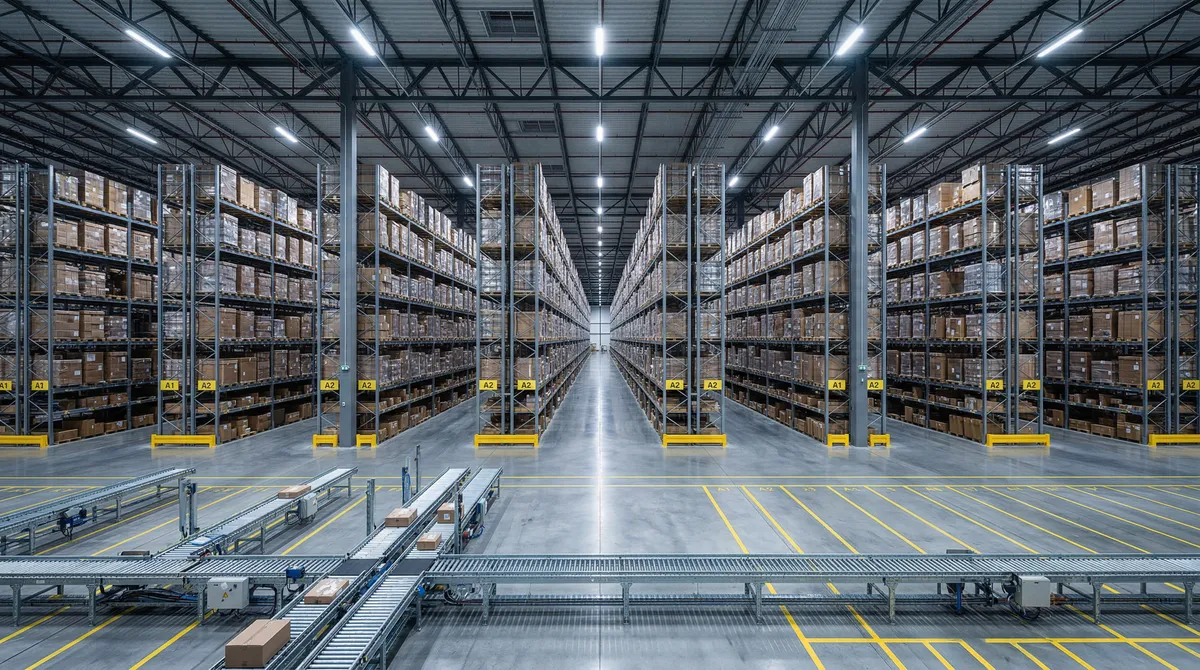
Worcester is one of the better industrial markets in New England right now, and the reason is geography. Prologis research has e-commerce companies accounting for 25% of new industrial leasing in 2026. Worcester sits where I-90, I-290, and I-190 meet, with 4.5 million people inside 50 miles and none of the Boston price tag. That is what makes it work for last-mile logistics.
E-commerce demand: E-commerce companies are projected to account for 25% of new industrial leasing by 2026, well up from where they have historically been.
Worcester's advantage: Worcester reaches 4.5 million people within 50 miles at a fraction of Boston's pricing, which is what a last-mile hub needs.
Utilization trigger: National warehouse utilization is expected to reach 85.5% by 2026, the point where tenants have to lease more space to keep growing.
Worcester market: Worcester County averages 2.1M SF available, $235/SF pricing, and 6.68% cap rates.
Last-Mile Logistics Hub is a distribution center placed near population centers to handle the final leg of getting a product to the customer, usually an e-commerce order.
E-commerce companies projected to account for 25% of new industrial leasing in 2026 (Prologis), up from historical 15-18%.
Worcester County industrial averages: 2.1M SF available, $235/SF, 6.68% cap rates across 19 listings.
Warehouse utilization reaching 85.5% nationally in 2026 (Prologis), the threshold that triggers a fresh round of leasing activity.
Worcester's strategic advantage: access to 4.5 million people within 50 miles at a fraction of Boston pricing.
Why the highways make Worcester a warehouse town
"Worcester is wonderfully situated to be a warehouse environment," Chris Crowley of Polar Beverages told me, and Polar is one of the largest industrial occupiers in the region. The highway access means product moves out fast to markets across New England and past it.
That is what is pulling demand for industrial space in Central Massachusetts, and it is picking up going into 2026.
The e-commerce engine
E-commerce keeps rewriting what industrial demand looks like. Prologis's 2026 Logistics Rent Index puts global e-commerce penetration near 20% of total retail sales by year-end 2026, up from about 15% in 2020, and every percentage point of that growth takes roughly 1.5 billion square feet of additional warehouse space globally. Prologis research has e-commerce companies at nearly 25% of new industrial leasing in 2026, a real jump from the 15-18% they used to run. Shoppers now expect same-day and next-day delivery, which pushes demand toward smaller buildings sitting closer to people. Worcester is within 50 miles of 4.5 million of them, which is exactly what a last-mile operation wants.
Supply and demand
The market is close to turning. After a heavy run of new construction in 2023-2024, supply is finally pulling back. Net new deliveries are projected to fall below annual absorption by 2026, which takes pressure off vacancy. Under baseline economic scenarios, vacancy should peak near 8% in late 2025 and drift down toward the mid-6% range over the years after. National warehouse utilization is expected to hit 85.5% in 2026. Once you cross 85%, tenants have to lease more space to hit their growth plans, and that kicks off a fresh round of leasing. Even with elevated vacancy in some markets, rents keep climbing where supply is tight. Worcester County industrial rents are up 15-20% since 2020.
Worcester County by the numbers
Here is what the Central Massachusetts industrial market looks like on paper:
| Metric | Value |
|---|---|
| Available Industrial Space | 2.1 million SF |
| Number of Listings | 19 properties |
| Average Price | $235/SF |
| Average Cap Rate | 6.68% |
| Major Highways | I-90, I-290, I-190 |
Worcester vs. Boston Industrial Comparison:
| Factor | Worcester County | Greater Boston |
|---|---|---|
| Avg. Price/SF | $235 | $400+ |
| Cap Rates | 6.68% | <5.0% |
| Highway Access | I-90, I-290, I-190 | I-93, I-95, Route 128 |
| Labor Costs | Lower | Higher |
| Development Sites | Available | Limited |
| Population within 50mi | 4.5 million | 5+ million |
The transportation cost angle most people miss
The one driver investors keep underrating is transportation cost. Trucking capacity is shrinking, and that is expected to push double-digit freight cost increases in 2026. As transportation eats up more of the total supply chain spend, a well-located building is worth more. Companies also keep moving inventory closer to the customer to cut delivery costs and times, and that regionalization favors a market like Worcester, which puts you next to dense population at a lower occupancy cost. 3PLs, including delivery operators like Ryder and DHL, are leading industrial demand. They want efficient buildings that can serve several clients, and they lean toward highway visibility and easy truck access.
What to check before you buy
What to Look For:
- Clear ceiling heights: Modern logistics wants 28-32' clear; older buildings with lower clearances carry obsolescence risk
- Truck court depth: 120' minimum to swing a trailer, 130-150' is better
- Column spacing: 50'+ column spacing fits modern racking
- Power availability: E-commerce and cold storage need real electrical capacity
- Sprinkler systems: ESFR sprinklers are required for high-pile storage
Challenges in Worcester:
- Brownfield Sites: A lot of the potential industrial ground here is old manufacturing land with contamination. Cleanup can run more than the site is worth and it stretches out the timeline.
- Operating Costs: Massachusetts industrial operating costs, utilities, labor, and taxes, run higher than a lot of competing regions. A tenant has to weigh that against the transportation savings.
My read for 2026
I expect industrial fundamentals in Worcester County to strengthen through 2026, for four reasons. E-commerce growth keeps tenant demand coming. Limited new supply supports occupancy and rent growth. Transportation cost inflation raises the value of well-located assets. And cap rate compression drives appreciation on stabilized properties.
If you are investing, the play I would run is buying existing assets at today's cap rates and being selective about developing modern buildings on good sites.
Lornell Real Estate currently represents over 2 million square feet of industrial space in Worcester County. Contact us to discuss available opportunities.
Limitations: Market data, projections, and trend analyses reflect conditions at publication. Commercial real estate markets are inherently cyclical, and submarket and property-level performance can diverge significantly from the regional averages cited. Demographic data, employer information, and regulatory conditions are subject to change. This article does not constitute investment advice. Conduct property-specific due diligence and consult qualified professionals before making investment decisions.
Sources & References
- Prologis
- Prologis research
This article cites data from the sources listed above. For the most current figures, consult the original publications directly.
Data current as of publication date. Market conditions, rates, and regulations may have changed. Consult a qualified commercial real estate professional before making investment decisions.
Get the full Central MA market data
Commercial tax-base growth, development activity, and demographics across Central MA, town by town.