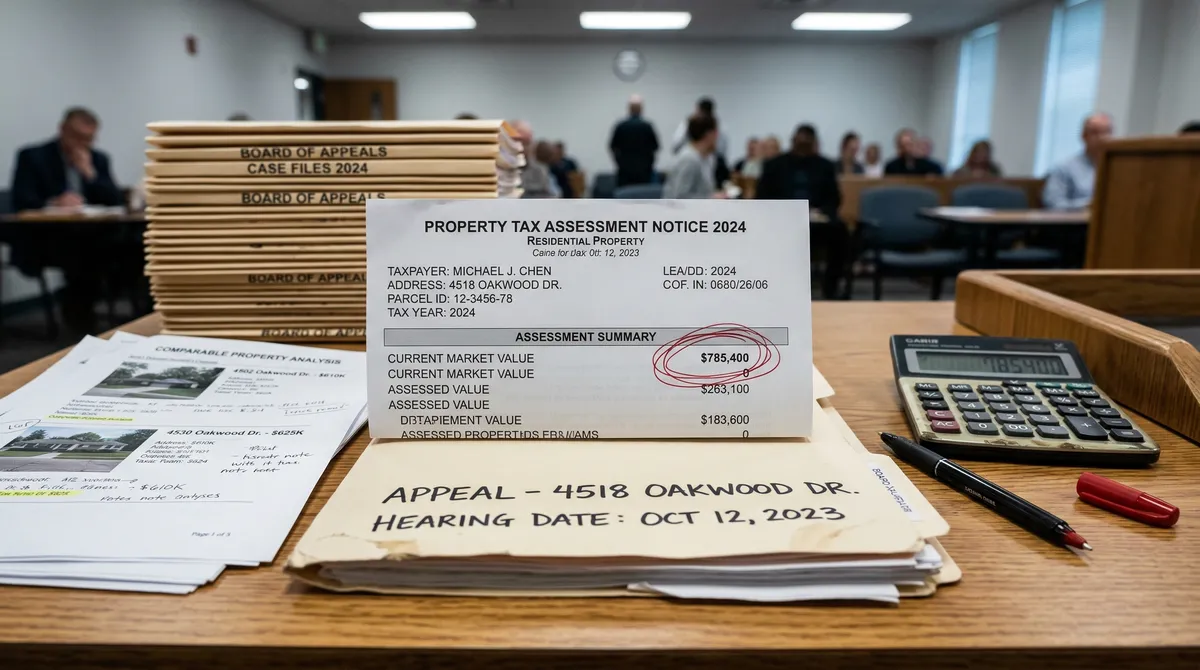
Somewhere between 40 and 60% of commercial properties in Massachusetts are over-assessed. That means most owners are paying more tax than they owe. The Massachusetts Department of Revenue puts commercial property taxes at 2-3% of assessed value a year, so a successful appeal on a $5 million property can save $10,000 to $50,000 or more annually. The downside is close to nothing: the assessment can't be raised while the appeal is running.
Over-assessment rate: Up to 60% of commercial properties are over-assessed, so there's real room to bring the tax bill down.
What it saves: A successful appeal on a $5 million asset can put $10,000 to $50,000 or more back in your pocket every year.
The deadline: In Massachusetts you file the abatement application by February 1 each year.
Your odds: Formal appeals at the Appellate Tax Board win 50-65% of the time for commercial properties.
The quick check: If your effective tax rate is over 2.5%, the property is probably over-assessed.
Over-assessment is when a commercial property's tax valuation is higher than what it would actually sell for, so the owner pays more tax than the law requires.
Over-assessment rate: 40-60% of commercial properties are over-assessed nationally (IAAO - International Association of Assessing Officers)
Annual tax burden: Massachusetts commercial property taxes average 2-3% of assessed value, or $100,000-$150,000 on a $5M property (Massachusetts DOR)
Filing deadline: Abatement applications due February 1 annually in Massachusetts using Form 128 (Massachusetts DOR)
Success rate: Formal appeals at the Appellate Tax Board succeed in 50-65% of cases for commercial properties (Massachusetts ATB)
Where the money is
Commercial property taxes in Massachusetts run 2-3% of assessed value a year. On a $5 million property, that's $100,000 to $150,000 a year.
Study after study puts the over-assessed share at 40-60%. If you're in that group, an appeal saves you thousands a year.
Why properties get over-assessed
Assessments lean on old data, so the market moves faster than the assessor does. Assessors also run statistical models across thousands of parcels at once, which means nobody is looking at your specific building. And most owners never appeal, so the assessor has no reason to lower a number on his own.
Reading your assessment
Massachusetts assessment calendar
| Date | Event |
|---|---|
| January 1 | Valuation date |
| Late Dec/Jan | Tax bills mailed |
| February 1 | Deadline to file abatement |
| 3 months from denial | Deadline to appeal to ATB |
Figuring your effective tax rate
Formula: (Assessed Value × Tax Rate) / Fair Market Value
If that rate comes out over 2.5%, you're probably over-assessed.
What you can appeal on
1. Overvaluation
The property is assessed above what it's actually worth.
Evidence types:
- Recent comparable sales
- Income approach using your actual NOI
- Independent appraisal
2. Disproportionate assessment
Your property is assessed high relative to comparable buildings.
3. Factual errors
Common errors:
- Wrong square footage
- Wrong property class
- Overstated land area
- Wrong construction year
Building the case
Income approach
For an income-producing property, this is usually your strongest argument.
Example calculation:
| Item | Amount |
|---|---|
| Gross Potential Income | $400,000 |
| Less: Vacancy (5%) | ($20,000) |
| Effective Gross Income | $380,000 |
| Less: Operating Expenses | ($140,000) |
| Net Operating Income | $240,000 |
| Cap Rate | 7.0% |
| Indicated Value | $3,428,571 |
If that property is assessed at $4,500,000, you've got a strong case.
How the appeal runs
Step 1: Informal review
Call the assessor's office before you file anything formal. A lot of this gets fixed right here.
Step 2: Abatement application
- File Massachusetts Form 128
- Due by February 1
- Attach your supporting documentation
Step 3: Local board decision
The board has to act within 3 months.
Step 4: Appellate Tax Board (ATB)
If they deny you, you file within 3 months of the denial.
Getting help
When to bring someone in
- Value over $1 million
- Reduction potential over $100,000
- A complicated property
- You're headed to the ATB
Who does this work
Property tax consultants usually work on contingency, 25-40% of the savings. Appraisers run $2,500 to $10,000 and up depending on the property. For the formal ATB procedure you need an attorney.
Does it pencil out
| Appeal Type | Cost | Break-Even Savings |
|---|---|---|
| Self-filed abatement | $0 | Any savings |
| Consultant (contingency) | 30% of savings | Always positive |
| ATB with attorney | $5,000-15,000 | $15,000-45,000 |
Lornell Real Estate can point you to property tax professionals who work Central Massachusetts commercial properties. Call us and we'll talk through your assessment.
Limitations: Lease rates, vacancy figures, and expense estimates cited represent Central Massachusetts market averages at publication and may not apply to specific properties or municipalities. Actual occupancy costs depend on individual lease terms, property condition, location, and landlord negotiations. Commercial lease structures vary significantly. This article does not constitute legal advice. Have a commercial real estate attorney review any lease before signing.
Sources & References
- Massachusetts Department of Revenue
This article cites data from the sources listed above. For the most current figures, consult the original publications directly.
Data current as of publication date. Market conditions, rates, and regulations may have changed. Consult a qualified commercial real estate professional before making investment decisions.
Get the full Central MA market data
Commercial tax-base growth, development activity, and demographics across Central MA, town by town.