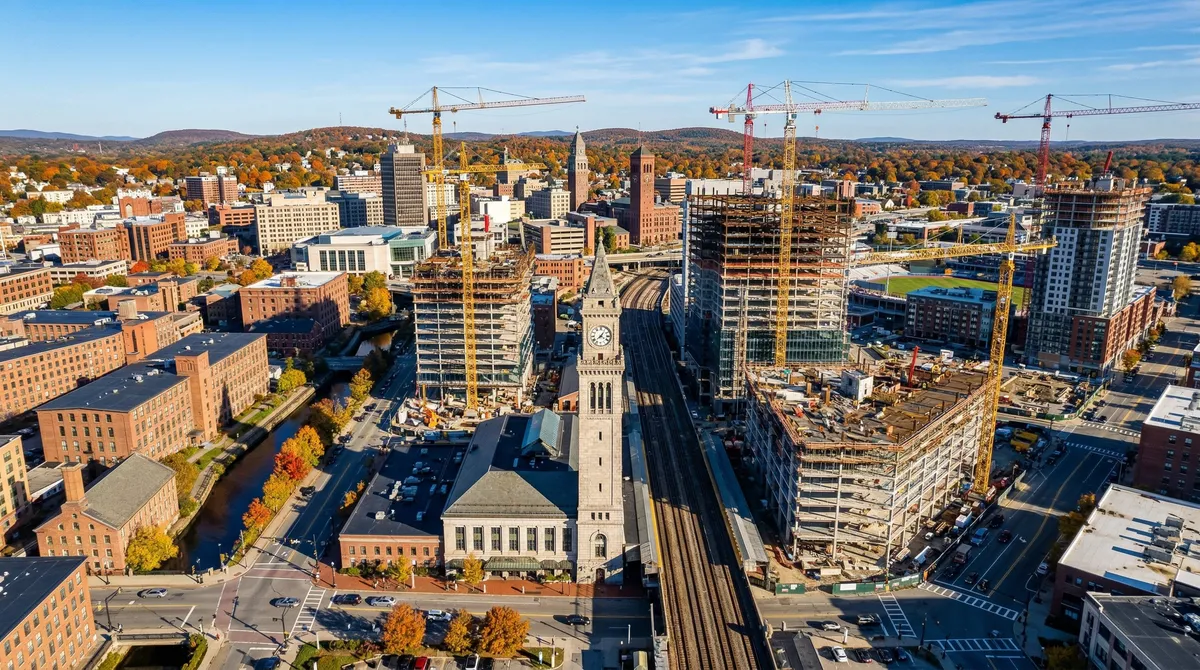
Worcester is in its biggest building cycle in decades. More than 1,600 housing units are under construction, a 51-acre industrial campus is in the pipeline, and over $161 million in state grants are coming into Worcester County. Realtor.com puts Worcester at #3 nationally for housing market growth in 2026, projecting 12.6% home sale growth. The city grew 14.1% between 2010 and 2020 (U.S. Census Bureau), and that population keeps pushing demand across every commercial sector.
Residential expansion: Worcester has over 1,600 new housing units under construction or breaking ground in 2026, reflecting significant demand.
Top housing market: The city ranks #3 nationally for housing market growth in 2026, projecting a 12.6% increase in home sales.
Significant grants: Over $161 million in state grants are flowing into Worcester County, funding various development and infrastructure projects.
Industrial growth: A 51-acre industrial campus is planned in Greendale for advanced manufacturing and logistics, boosting the regional economy.
Mixed-use development is a type of urban planning that integrates residential, commercial, cultural, institutional, or industrial uses into a single project or building, creating vibrant and walkable communities.
Housing pipeline: 1,600+ units under construction or breaking ground in 2026 (City of Worcester)
National ranking: #3 housing market for growth in 2026, with 12.6% projected home sale growth (Realtor.com)
State investment: $161+ million in MassWorks, HousingWorks, and related grants flowing into Worcester County (Massachusetts EOHLC)
Industrial expansion: 51-acre campus in Greendale area planned for advanced manufacturing and logistics (City of Worcester)
A city that has been building toward this
Worcester spent years building momentum, and in 2026 you can see it on nearly every major corridor. This is the second-largest city in New England, population around 206,000, up 14.1% between 2010 and 2020, and now the fastest-growing city over 100,000 residents in the region. Realtor.com ranked it #3 nationally for housing market growth in 2026, projecting 12.6% home sale growth and 2.4% price appreciation. Median home prices are up to roughly $450,000, a 4.7% gain year-over-year.
So what does a city growing this fast actually build? Below is every major project breaking ground or moving through construction this year, and what each one means if you own or buy commercial real estate.
Residential: 1,600+ units in the pipeline
Worcester has roughly 1,600 new housing units under construction or breaking ground in 2026, covering affordable, mixed-income, market-rate, and senior housing. Three projects are worth watching.
The Pearl
The Pearl is tentatively breaking ground in early 2026, and it is one of the mixed-use projects I get asked about most. It sits in the Canal District, which already has Polar Park and a growing restaurant scene, and it adds density to an area that went from underused industrial parcels to a walkable neighborhood in a short stretch of years.
Lakeside Redevelopment Phase 3
Lakeside is into its third construction phase in 2026, with a linear park planned to connect the community to the amenities around it. The phasing tells you something: every prior phase leased up fast. That is Worcester's relative affordability against Boston's $750,000+ median, plus better transit, doing the work.
WinnDevelopment Lincoln Square Boys and Girls Club
WinnDevelopment is putting $51 million into converting the historic Lincoln Square Boys and Girls Club into 80 affordable apartments for adults 55 and older. It handles two problems at once: it saves a historically significant building, and it adds senior housing in a market where the 55+ group is growing faster than the population overall.
Worcester Memorial Auditorium
The redevelopment of the Worcester Memorial Auditorium keeps moving as an adaptive reuse project, turning a historic civic building into a modern mixed-use destination. It fits the city's pattern of using old architecture to pull in investment instead of knocking it down.
What residential growth means for CRE
| Metric | Impact |
|---|---|
| New housing units | ~1,600 under construction |
| Population growth (2010-2020) | 14.1% |
| National housing market rank | #3 (Realtor.com, 2026) |
| Median home price | ~$450,000 (+4.7% YoY) |
Every 1,000 new residents need roughly 15,000 to 20,000 SF of neighborhood retail. At Worcester's growth rate, that demand compounds year over year. Grocery-anchored centers, quick-service restaurants, medical office, and service retail (laundromats, salons, urgent care) all benefit as residential density climbs. If you buy here, watch the retail pad sites and inline vacancies near these residential projects.
Industrial and manufacturing
Worcester County's 2026 industrial story runs well past the city line, but a few projects are moving the metro's competitive position.
Greendale industrial campus: 51 acres, ~1 million SF
NGP is redeveloping a 51-acre industrial campus in the Greendale section of Worcester into roughly 1 million SF of modern manufacturing and industrial space. This is the kind of project that resets a submarket. Modern clear heights, updated loading, and I-290 access will pull users who currently pay a lot more for space in Metro West or along I-495.
Route 146 corridor
South of Worcester, the Route 146 corridor is stacking up real volume:
- Unified2 Global Packaging, 1 million SF facility in Sutton
- Blackstone Logistics Center, 640,000 SF
- Cubes at Gilboa, 1.1 million SF in Douglas
Those three alone are nearly 2.75 million SF of new industrial inventory coming into the southern Worcester County market. For perspective, that is more industrial space than a lot of smaller New England markets hold in total.
What this means for industrial investors
The Route 146 corridor and the Greendale campus move Worcester County from a secondary industrial market to a real regional logistics node. Properties along I-290, I-190, Route 146, and I-90 with modern specs (28'+ clear heights, ESFR sprinklers, enough trailer parking) will trade at tighter cap rates as institutional money follows the infrastructure. Older industrial in Spencer, Leicester, and Auburn benefits too: tenants priced out of new Class A product will go looking for functional, affordable space in the towns around it.
Life sciences and biotech
Greater Boston's life sciences market gets the headlines and the $80+/SF lab rents. Worcester is building a credible cluster for a fraction of that.
The numbers
| Metric | Data |
|---|---|
| Life sciences/lab space in pipeline | 1.1 million SF |
| UMass Medicine Science Park occupancy | 100% (with waitlist) |
| New biotech startups at MBI (Q1 2025) | 7 |
| Worcester County share of state biomanufacturing jobs | ~25% |
| Biomanufacturing employment growth | 7.9% increase |
UMass Medicine Science Park is 100% occupied with a waitlist. When space is that full, demand has already outrun supply. The Massachusetts Biomedical Initiatives (MBI) incubator signed 7 new biotech startups in Q1 2025 alone, and those companies will eventually need 5,000 to 20,000 SF of lab and flex space as they grow.
Worcester County already holds nearly 25% of the state's biomanufacturing jobs, and that employment grew 7.9%. The county leans toward biomanufacturing rather than the drug discovery and clinical research that dominates Cambridge, and that is a different but just as durable growth path.
What life sciences means for CRE
Lab-ready and flex space is the clearest supply-demand gap in the Worcester market. If you can deliver spec lab suites in the 3,000 to 15,000 SF range, you are set up to catch tenants coming out of the MBI and UMass programs. Properties near UMass Medical School, WPI, and the existing biotech cluster along Route 9 and Plantation Street carry a location premium. I expect lab/flex rents to move toward $25-30/SF NNN while supply stays tight through 2027.
State capital coming in: $161 million in grants
Governor Healey's announcement of over $161 million in state economic development grants for Worcester County is a tailwind that reaches past any single project. These grants pay for infrastructure, roads, utilities, brownfield remediation, that cut development costs and take risk off private investment.
For commercial real estate, public infrastructure dollars multiply. A $5 million sewer extension into an industrial park does not just serve the one user; it opens up the surrounding land for future development. Track the MassWorks grants, brownfield remediation awards, and TIF agreements. They tell you where the next wave of private development money is headed.
How I would position in 2026
Worcester's development cycle is not a guess. It is underway, funded, and permitted. The real question is where to put capital for the best risk-adjusted return.
High-conviction plays
- Neighborhood retail near new residential density: 1,600 new housing units need services. Go after inline retail and pad sites within a mile of the major residential projects.
- Functional industrial in the suburban towns: Spencer, Leicester, Auburn, and Charlton industrial gets the overflow as tenants priced out of Class A new construction in Worcester and along Route 146 look for something they can afford.
- Lab/flex conversion: Older industrial or flex buildings near UMass Medical School and WPI that you can reposition for life sciences tenants at a $15-20/SF basis are the highest-upside value-add play in this market.
- Land banking along Route 146: The corridor is turning into a logistics hub, and it is accelerating. Entitled industrial land there will appreciate as the cluster fills in.
Metrics to watch
| Indicator | Why It Matters |
|---|---|
| Worcester building permits (monthly) | Leading indicator of construction pipeline |
| Route 146 absorption rate | Measures logistics hub demand |
| UMass Science Park waitlist depth | Signals lab space demand |
| MBI startup graduations | Future tenants for 5,000-20,000 SF lab space |
| Residential occupancy rates | Validates retail demand thesis |
My read
Worcester is not "up and coming." It is here. A city that grew 14.1% in one census decade, ranked #3 nationally for housing market growth, and is taking in over $161 million in state infrastructure investment is not a secondary-market bet anymore. It is a primary-market opportunity still priced like a secondary one.
The projects breaking ground in 2026, from The Pearl to the Greendale industrial campus to 1.1 million SF of life sciences pipeline, are creating demand for every commercial property type. The buyers who move now, while cap rates still carry Worcester's old discount to Boston, will get the most out of it as the market reprices to its fundamentals.
Lornell Real Estate tracks every development project, zoning change, and infrastructure investment across Worcester County. Contact us to discuss how these trends affect your portfolio or acquisition strategy.
Limitations: Development timelines, construction costs, and regulatory requirements cited represent typical ranges and vary significantly by municipality, site conditions, environmental factors, and project scope. Permitting timelines depend on local planning boards and zoning requirements that change independently. Tax credit programs have specific eligibility criteria and application deadlines. This article does not constitute development or legal advice. Engage qualified architects, engineers, attorneys, and environmental professionals for project-specific guidance.
Sources & References
- Census Bureau
- City of Worcester
- Massachusetts EOHLC
- Realtor
- Realtor.com, 2026
- U.S. Census Bureau
This article cites data from the sources listed above. For the most current figures, consult the original publications directly.
Data current as of publication date. Market conditions, rates, and regulations may have changed. Consult a qualified commercial real estate professional before making investment decisions.
Get the full Central MA market data
Commercial tax-base growth, development activity, and demographics across Central MA, town by town.