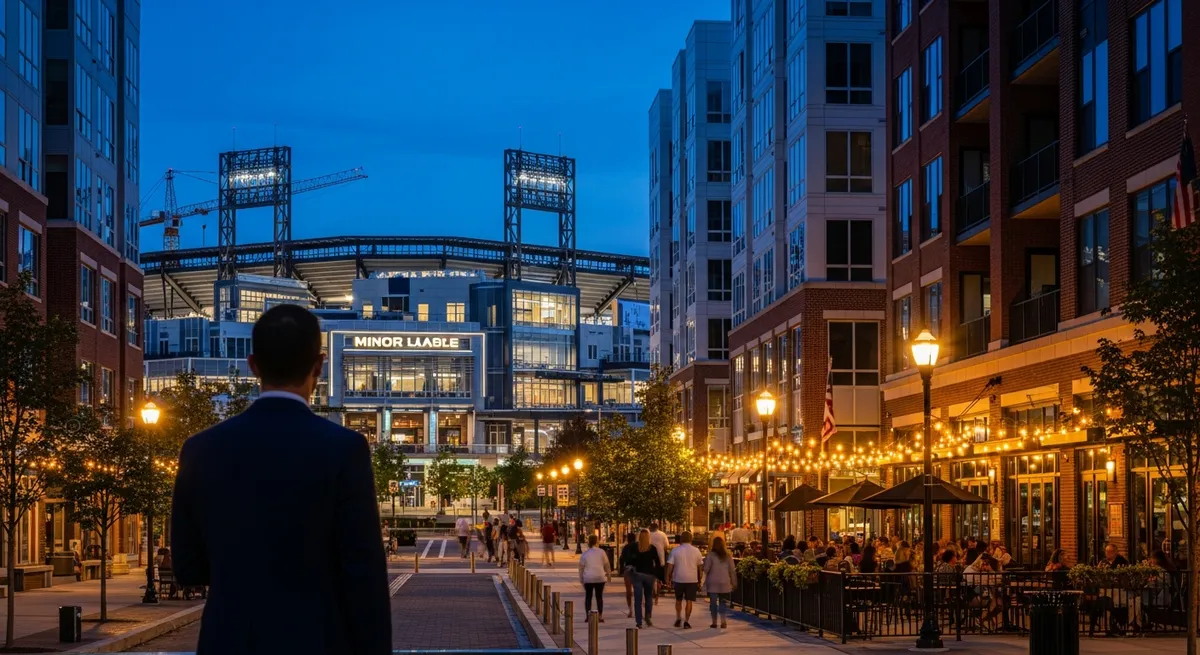
In August 2018, when the Pawtucket Red Sox announced they were moving to Worcester, the Canal District was a roughly 12-block triangle of wholesale businesses, aging industrial buildings, and a contaminated brownfield. Within months of that announcement, property sales in the district jumped 72% and the combined dollar value of those sales rose 183%.
Major Investment: Over $500 million in public and private investment has driven the Canal District's emergence as Worcester's fastest-growing commercial submarket since 2018.
Value Surge: Assessed property values in the Canal District have surged 83% since Polar Park opened in 2021, more than double the citywide rate.
Key Location: The entire Canal District is situated within a federal Opportunity Zone, providing investors with potential capital gains deferral and elimination benefits.
Residential Growth: More than 800 new apartment units are in various stages of development, signaling significant residential expansion near Polar Park.
Enhanced Connectivity: The district benefits from its proximity to Worcester Union Station, offering direct MBTA Commuter Rail access to Boston South Station.
Federal Opportunity Zone is a designated economically distressed community where new investments, under certain conditions, may be eligible for preferential tax treatment on capital gains, including deferral or elimination.
Seven years later, the change is real, and it's still moving. Polar Park has drawn over 2 million visitors across four seasons. Assessed property values in the Canal District are up 83% since 2021, more than double the citywide rate of 41.3%. And roughly 800 new apartment units are at various stages of development within walking distance of the ballpark.
If you're an investor, a tenant, or a developer, the Canal District gives you something I don't see often: a clearly defined neighborhood in an early-to-mid stage of change, inside a federal Opportunity Zone, with institutional-quality infrastructure already in the ground.
Property values up 83% since 2021 - Canal District assessed values rose from $87.4 million to $159.9 million (excluding Polar Park), versus 41.3% citywide.
Over 2 million visitors in four seasons - The WooSox have crossed 500,000 tickets every year since Polar Park opened in 2021, the only MiLB franchise to do so.
800+ apartment units in the pipeline - The Revington (228 units), The Cove (173 units), District 120 (83 units), and 300+ additional units in development.
Federal Opportunity Zone - The entire Canal District falls within a designated Opportunity Zone, offering capital gains deferral and potential elimination for long-term investments.
$16 million Kelley Square redesign - The infamous seven-way intersection was reconstructed into a modern roundabout, removing a major safety and access barrier.
What the Canal District is today
The Canal District covers about 12 blocks in a triangle between I-290 and the Providence & Worcester railroad tracks, with the redesigned Kelley Square at the northern tip and Green Street and Harding Street forming the sides. Downtown Worcester sits to the north, the Green Island neighborhood to the south.
The district is now a mixed-use neighborhood that pulls together:
- A professional sports venue: Polar Park, the 9,508-seat home of the Worcester Red Sox (Triple-A affiliate of the Boston Red Sox)
- A food and entertainment destination: The Worcester Public Market (24 vendors from 14 countries), dozens of restaurants and bars, and a growing nightlife scene
- A residential growth center: New luxury, market-rate, and affordable apartments coming online across several projects
- A transit hub: Worcester Union Station, the western terminus of the MBTA Commuter Rail, sits next to the district with direct service to Boston South Station
What sets the Canal District apart from most urban revitalization stories is the infrastructure. The $159.5 million Polar Park, the $16 million Kelley Square redesign, the Union Station platform expansion, and 7,300+ structured parking spaces within walking distance add up to a level of public investment most secondary-market neighborhoods never see.
The Polar Park effect on property values
The clearest measure of what's happened here is assessed value:
| Year | District Assessment (ex-Polar Park) | Change |
|---|---|---|
| 2021 | $87.4 million | Baseline |
| 2024 | $159.9 million | +83% |
| Citywide comparison | - | +41.3% |
Include the Polar Park parcel itself (which went from $13.1 million in January 2021 to $146 million in 2024) and the combined district assessment is up 204%.
The ballpark was designed to spill over on purpose. Polar Park's parking plan spreads over 7,300 spaces across the broader district instead of stacking them next to the stadium. Fans walk Canal District streets to get to the ballpark, past restaurants, bars, and retail storefronts. That's a deliberate choice, and it turns every game into a marketing event for the businesses around it.
Attendance as a commercial driver
| Season | Total Attendance | Per-Game Average | National MiLB Rank |
|---|---|---|---|
| 2021 | 500,000+ | ~7,100 | Opening year |
| 2022 | 532,152 | ~7,400 | #2 nationally (all 120 MiLB teams) |
| 2023 | 519,551 | 7,424 | Top tier |
| 2024 | 500,000+ | ~6,490 | Consistent draw |
With roughly 75 home games a season, Polar Park puts foot traffic on the streets nearly every day from April through September. The WooSox are the only Minor League Baseball franchise to cross the 500,000-ticket line in each of their first four seasons.
For a restaurant or a retailer, that's a customer base you can't get anywhere else in Worcester. For a property owner, it's a steady demand driver that holds up premium rents.
Development pipeline: what is being built
Completed and open
| Project | Units/Size | Developer | Status |
|---|---|---|---|
| The Revington | 228 apartments (studio-2BR) | Madison Properties | Open; leasing |
| District 120 | 83 affordable apartments | Tremont Development Partners | Opened 2024 |
| Worcester Public Market | 24 vendors, 20,000+ SF | Multiple | Operating |
| UniBank branch | First commercial tenant at The Revington | UniBank | Opened August 2024 |
The Revington is the district's first big residential delivery. Rents run from $1,894/month for studios to $3,441/month for 2BR/2BA units, premium pricing that reflects a brand-new product in a neighborhood that's repositioning.
Under construction or near completion
| Project | Units/Size | Developer | Timeline |
|---|---|---|---|
| The Cove | 173 luxury apartments | V10 Development | Near completion |
| Table Talk site - Phase 1 | 53 affordable apartments + commercial | Rossi Development | Completed |
| Table Talk site - Phase 2 | 83 workforce housing units | Boston Capital / Quarterra | Completed |
In pipeline
| Project | Units/Size | Developer | Status |
|---|---|---|---|
| Table Talk site - Phase 3 | 375 market-rate apartments | Quarterra Multifamily | Planned |
| Table Talk site - additional | 185 apartments | Watertown-based developer | Proposed |
| Rossi Development | 46 studio apartments + 1,500 SF commercial | Rossi Development | Proposed |
| Flatbread Pizza building | 7-story mixed-use | - | Authorized |
| Madison Properties (remaining) | Hotels, office, life sciences | Madison Properties | Delayed/uncertain |
The Madison Properties question
The biggest open question in the Canal District is Madison Properties, the Boston developer that committed to $140 million in private investment around Polar Park. Their original plan had two hotels, a second residential building, an office building, and a life sciences facility. As of early 2026, only The Revington is finished. Madison terminated its 15-year Tax Increment Financing (TIF) agreement with the city in November 2024, which puts the rest of those projects in question.
That TIF termination matters because the TIF was a key revenue source for the District Improvement Financing (DIF) fund that services Polar Park's debt. In FY2024 the DIF fund ran a $792,000 shortfall, with gaps in real estate taxes ($344,594), meals and use taxes ($62,496), and building permits ($384,979).
What this means for investors: the Madison delay is opportunity. The unbuilt parcels, the hotel sites, the life sciences building, the second residential project, are development plays that could open up to other developers if Madison doesn't move forward. At the same time, the DIF shortfall puts pressure on the city to bring in replacement investment, and that can mean better terms for a developer coming in now.
The commercial landscape
Restaurant and retail scene
The food and entertainment side has filled in fast. Some of the destinations:
- Worcester Public Market (160 Green Street): 24 vendors from 14 countries, including Wachusett Brew Yard, Legacy Deli & Bagel, Akra Eatery (West African cuisine), BubbleBee Cafe (Asian fare), and One Love Cafe (Jamaican)
- 107 TAP, Femme Bar, 1885, Blackstone Herbs and Martini Bar: bars and restaurants that have opened since 2021
- Bay State Shawarma & Grill, Mai Tai Sushi and Bar, El Patron Mexican Restaurant: a range of dining options that reflect Worcester's demographic mix
The neighborhood is eclectic on purpose: juice bars next to bodegas, craft cocktail spots alongside ethnic restaurants, a professional baseball stadium next to a public market. I read that mix as a strength, not a knock. It brings different customers at different times of the day and the week.
Retail and office opportunity
Commercial buildout here is still early. The Revington's ground-floor commercial spaces only started leasing in 2024, with UniBank as the first tenant. What that means:
- Ground-floor retail: several new-construction spaces are still available across Canal District projects. An early tenant gets below-stabilization rents and the chance to build a customer base while the neighborhood grows
- Office: no major office construction has been delivered in the Canal District itself (CitySquare's 640,000 SF Mercantile Center is adjacent, downtown). Office demand here is an open question. Right now the district's identity is residential and entertainment
- Service-oriented businesses: medical, dental, fitness, personal services, and specialty retail all have room to serve a residential population that's growing fast
Infrastructure advantages
Transit access
The Canal District has infrastructure most secondary-market neighborhoods don't get:
- Union Station: MBTA Commuter Rail terminus with direct service to Boston South Station (~60-75 minutes). A new high-level center-running platform opened July 2024, improving capacity and accessibility. The station also serves Amtrak (Lake Shore Limited), WRTA buses, Peter Pan, and Greyhound, so it's a true intermodal hub
- Highway: I-290 runs along the east side, with direct access to I-90 (Mass Pike to Boston), I-190 (north to Leominster/Fitchburg), and I-395 (south to Connecticut)
- Parking: 7,300+ spaces within walking distance, with another 1,000 being added
Kelley Square redesign
The $16 million reconstruction of Kelley Square, once one of the most dangerous and confusing intersections in Massachusetts, into a modern peanut-shaped roundabout wrapped up in 2020-2021. The redesign:
- Eliminated the seven-way intersection that kept visitors from entering the district
- Added wider sidewalks and bike infrastructure
- Created a gateway into the Canal District from downtown Worcester
- Was a precondition for handling the influx of Polar Park visitors
Investment incentives
Federal Opportunity Zone
The Canal District sits in one of Worcester's six designated federal Opportunity Zones. For an investor, that gives you:
- Deferral of capital gains invested through a Qualified Opportunity Fund (QOF)
- Step-up in basis after 5 years (10% exclusion) and 7 years (15% exclusion) for investments made before December 31, 2026
- Elimination of capital gains on QOF investment gains if held for 10+ years
- No cap on investment size: unlike a lot of incentive programs, Opportunity Zone benefits scale with the size of the investment
If you're selling a property somewhere else and staring at a big capital gains bill, reinvesting those gains into a Canal District Opportunity Zone project can defer the tax, cut the eventual bill by up to 15%, and wipe out all tax on the new investment's appreciation if you hold it for a decade.
Tax Increment Financing (TIF)
The City of Worcester offers TIF agreements that give relief from new property taxes tied to the value increment private development creates. TIF terms run from 0-100% relief and can extend up to 15 years. With the DIF fund short, the city has real incentive to approve TIF deals that bring new investment in.
Historic Tax Credits
Eligible historic structures in the Canal District may qualify for federal and state historic tax credits, which can offset 20-25% of qualified rehabilitation costs. Several buildings here predate the current development wave and may qualify.
Economic Development Incentive Program (EDIP)
The state offers a 5% tax credit on renovation costs and capital acquisitions with a depreciable life of four or more years. Buildings vacant for 24+ months may qualify for a one-time 10% corporate tax deduction on renovation costs.
Risks and considerations
DIF fund sustainability
The District Improvement Financing fund that services Polar Park's 35-year debt ran a $792,000 shortfall in FY2024. Madison Properties' TIF termination pulls a projected revenue stream out of it. If the DIF fund keeps underperforming, the city may have to backfill it from the general fund, and that can create political pressure that affects how available development incentives are. I'd watch the DIF fund's annual numbers as a read on how willing the city is to keep supporting Canal District investment.
Construction and delivery risk
Several developers have pointed to financing trouble, materials shortages, and labor constraints for their timeline delays. The 800-unit pipeline is real but may take longer to deliver than first projected. If you already own here, that's arguably a positive: slower new supply means less competition for tenants.
Absorption of new supply
The Revington still had 118 units available to lease as of August 2024, which tells me the district's residential market is absorbing new supply at a moderate pace. Premium rents ($1,894-$3,441/month) put Canal District apartments at the top of the Worcester market, which narrows the tenant pool to higher-income professionals, medical workers, and university-affiliated people.
Neighborhood evolution
The Canal District is still filling in. The ground-floor commercial buildout isn't finished. The restaurant and entertainment scene is growing but not yet as dense as, say, Shrewsbury Street. And the eastern edge, closer to Green Island, is at an earlier stage of change. None of that is necessarily a negative. It's where the value creation still is.
The investment thesis
I see the Canal District as a commercial real estate opportunity built on three things lining up at once:
- Public infrastructure already in place: $159.5 million ballpark, $16 million intersection redesign, expanded transit station, 7,300+ parking spaces. The heavy lifting is done. Private capital is now building on top of public investment
- Early-to-mid stage value creation: values are up 83% but the district is nowhere near built out. Madison Properties' unbuilt parcels, incomplete ground-floor commercial, and pending residential deliveries mean there's years of runway left
- Stacked incentives: Opportunity Zone benefits, TIF availability, historic tax credits, and EDIP tax credits layer together into an incentive structure that can materially improve returns
If you're comparing the Canal District to other Worcester neighborhoods, I don't think that's the right comparison. No other area here combines a professional sports venue, transit infrastructure, an Opportunity Zone designation, and an active development pipeline. The right comparison is early-stage urban redevelopment districts in other markets, where the people who moved first captured most of the value.
Lornell Real Estate provides investment sales and leasing advisory services across Worcester and Central Massachusetts. If you are evaluating a Canal District investment, development opportunity, or commercial lease, contact us at (860) 305-7432 for market data and property-level analysis.
Related articles: Worcester's Development Boom: Every Major Project Breaking Ground in 2026 | Why 2026 Is the Year to Invest in Central MA | Multifamily Investing in Worcester | Opportunity Zones in Central MA
Limitations: Market data, projections, and trend analyses reflect conditions at publication. Commercial real estate markets are inherently cyclical, and submarket and property-level performance can diverge significantly from the regional averages cited. Demographic data, employer information, and regulatory conditions are subject to change. This article does not constitute investment advice. Conduct property-specific due diligence and consult qualified professionals before making investment decisions.
Sources & References
- City of Worcester
- Green Street
- MBTA
This article cites data from the sources listed above. For the most current figures, consult the original publications directly.
Data current as of publication date. Market conditions, rates, and regulations may have changed. Consult a qualified commercial real estate professional before making investment decisions.
Get the full Central MA market data
Commercial tax-base growth, development activity, and demographics across Central MA, town by town.